
The Sukanya Samriddhi Yojana is a government savings account for a girl child. You can open it before she turns 10, deposit ₹250 to ₹1,50,000 a year for 15 years, and collect it at 21 years. The rate is 8.2% for October to December 2026, but it is reset every quarter. It suits a long, locked goal, not an emergency fund. Check the returns on Sukanya Samriddhi Yojana (SSY) with the 1% Club SSY Calculator now.
Want to know if the deposit fits your budget?
Download the 1% Club app to try AI CFO
Connect your accounts and ask: “How much can I safely set aside each month?”
Table of Contents · 14 sections
What Is the Sukanya Samriddhi Yojana?
The Sukanya Samriddhi Yojana (SSY) is a small savings scheme for girl children, launched on 22 January 2015 as part of the Beti Bachao, Beti Padhao campaign. A parent or legal guardian opens the account in the girl’s name at a post office or an authorised bank. The government’s own factsheet says over 4.1 crore Sukanya Samriddhi Yojana accounts had been opened by November 2024.
Think of it as a long, locked savings goal. You pay in for 15 years, the money keeps earning for six more, and access is limited along the way. That structure is the reason it works well for some goals and badly for others, and this guide covers both sides of the Sukanya Samriddhi Yojana.
Sukanya Samriddhi Yojana Rules at a Glance
These are the core rules of the Sukanya Samriddhi Yojana in one place.
| Feature | Rule |
|---|---|
| Who can open it | A natural or legal guardian, for a girl who has not turned 10 on the day of opening |
| Accounts | One per girl, and normally two girls per family |
| Minimum deposit | ₹250 in a financial year, then multiples of ₹50 |
| Maximum deposit | ₹1,50,000 in a financial year |
| Deposit period | 15 years from opening |
| Maturity | 21 years from opening |
| Interest | Rate notified by the government each quarter |
| Where | Authorised post offices and banks, and the account can be transferred between them |
Sukanya Samriddhi Yojana Eligibility and Age Limit
The age limit is simple: The girl child must be under 10 on the date of opening. The girl must also be a resident Indian citizen, and the application form asks for a declaration to that effect. Only a natural or legal guardian can open the account.
A grandparent should not assume they can open one: unless they are the legally accepted guardian, they should check the guardian position with the branch first.
A family can normally hold accounts for two girls. If a second birth is twins, or a first birth is triplets, a third account can be allowed with a birth certificate and an affidavit. Accounts beyond the permitted number can be treated as opened against the rules, so do not open an extra account on the assumption that it will be accepted.
Sukanya Samriddhi Yojana Documents
You need the account opening form, the girl’s birth certificate, and identity and address proof of the guardian under KYC (know your customer) norms. The exact checklist can differ between a post office and a bank, so ask your chosen branch for its current list before you go.
Sukanya Samriddhi Yojana Timeline: Year 0 to Year 21
Counting from the day the account opens, the Sukanya Samriddhi Yojana runs on this schedule:
- Year 0: Open the account for a girl under 10 with at least ₹250.
- Years 1 to 15: Deposit ₹250 to ₹1,50,000 in every financial year.
- After year 15: No more deposits are accepted, but the balance keeps earning interest.
- At 18 or Class 10, whichever is earlier: The education withdrawal becomes available.
- Year 21: The account matures, and the balance is paid out.
Sukanya Samriddhi Yojana Interest Rate
The Sukanya Samriddhi Yojana interest rate is 8.2% a year for the October to December 2026 quarter, the same as in the quarters before it. In the same quarter, the Public Provident Fund (PPF) pays 7.1%.
Two things matter more than the headline number:
- The rate is not fixed for 21 years. The government reviews small savings rates every quarter. A quarter’s rate can stay the same, rise or fall, so 8.2% today is not a promise for 2047.
- Timing of the deposit matters. Interest is calculated monthly on the lowest balance between the 5th and the end of the month, and it is credited once a year at the end of the financial year. A deposit made after the 5th does not earn interest for that month.
Check the latest notification before you act, because a quarterly rate can change.
Sukanya Samriddhi Yojana Interest Rate History
The Sukanya Samriddhi Yojana rate has moved between 7.6% and 9.2% since the scheme began. Here is the rate by period, which also answers what it was in 2020, 2023 or 2025:
| Period | Rate a year |
|---|---|
| December 2014 to March 2015 | 9.1% |
| April 2015 to March 2016 | 9.2% |
| April to September 2016 | 8.6% |
| October 2016 to March 2017 | 8.5% |
| April to June 2017 | 8.4% |
| July to December 2017 | 8.3% |
| January to September 2018 | 8.1% |
| October 2018 to June 2019 | 8.5% |
| July 2019 to March 2020 | 8.4% |
| April 2020 to March 2023 | 7.6% |
| April to December 2023 | 8.0% |
| January 2024 to December 2026 | 8.2% |
The 8.2% you see today is a middle value. The next section shows how much the 21-year result changes if the rate lands at either end of this range.
Sukanya Samriddhi Yojana Calculator: What Your Deposits Could Become
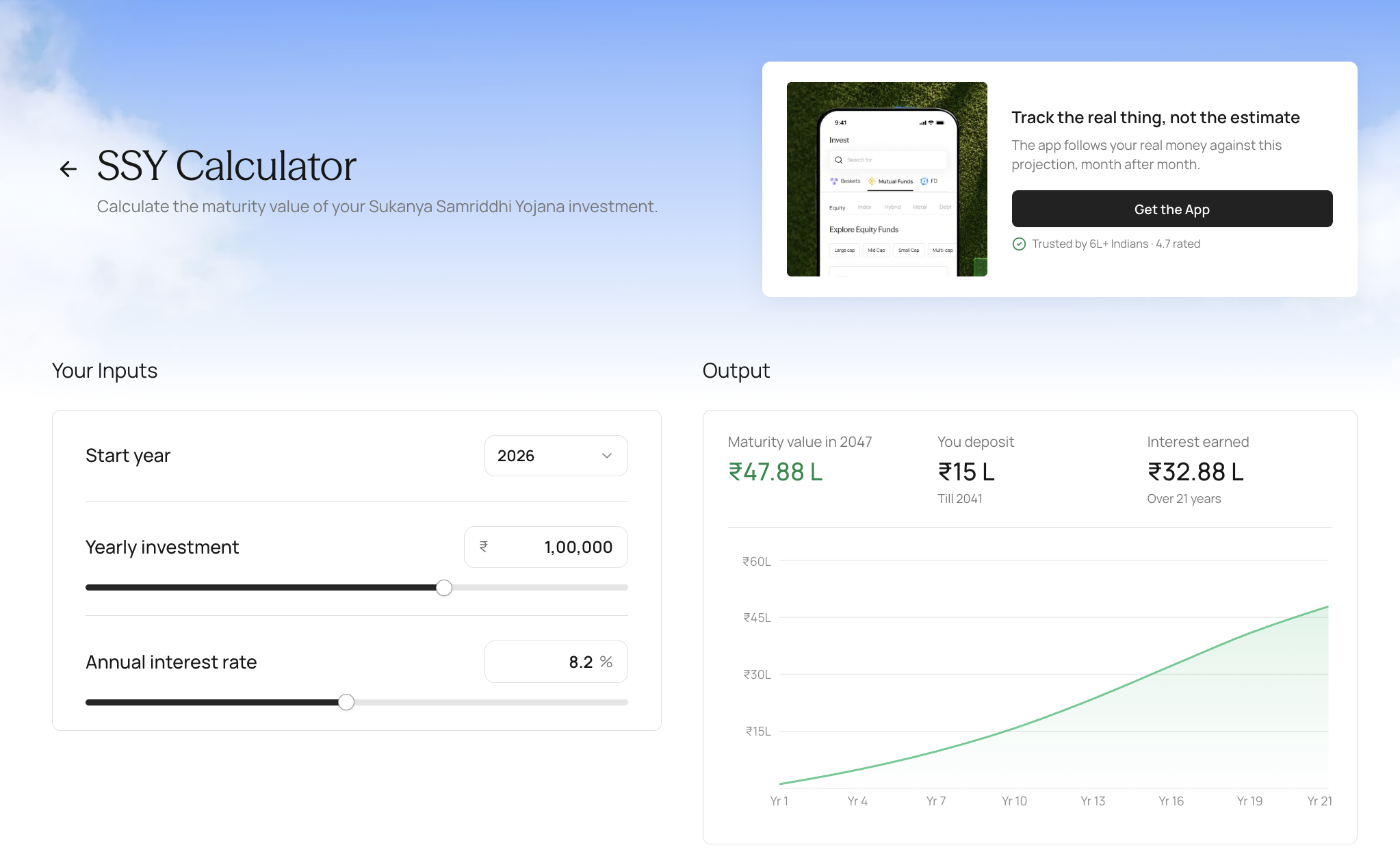
Numbers make the Sukanya Samriddhi Yojana easier to judge. Every figure below uses one formula and these assumptions: the account opens in April, the rate stays at 8.2% for all 21 years, deposits run for 15 years, and interest is added at the end of each financial year. The amounts are exact to the nearest rupee under those assumptions. They are an illustration, not a forecast, and a passbook can differ by a few rupees because interest is rounded every year.
With A as the yearly deposit and r as the rate, paid at the start of each of 15 years and held to year 21, the maturity amount is:
Maturity amount = A × [(1 + r)^22 minus (1 + r)^7] ÷ r
At 8.2%, the factor is 47.88,
so every ₹1 deposited each year for 15 years becomes ₹47.88 at year 21.
| Saved each month | Total deposited | Paid once a year in April | Paid monthly by the 5th |
|---|---|---|---|
| ₹1,000 | ₹1,80,000 | ₹5,74,570 | ₹5,54,612 |
| ₹2,000 | ₹3,60,000 | ₹11,49,139 | ₹11,09,224 |
| ₹5,000 | ₹9,00,000 | ₹28,72,848 | ₹27,73,059 |
| ₹12,500 | ₹22,50,000 | ₹71,82,119 | ₹69,32,648 |
Here is how to read it. The ₹12,500 row is the yearly ceiling of ₹1,50,000. Paying the whole year’s amount in April gives the full year of interest, while monthly deposits end up 3.47% lower because the money goes in gradually. In the top row, ₹1,000 a month builds only ₹5,74,570, so a small deposit will not fund a large goal.
In the ₹12,500 row, ₹49,32,119 of the ₹71,82,119 is interest. The balance is ₹44,75,989 at year 15, and the last six years add another ₹27,06,130 without a single deposit. That is why the account runs for 21 years, not 15.
What If the Sukanya Samriddhi Yojana Rate Changes?
The rate is reviewed every quarter, so here is the ₹1,50,000 a year case at four constant rates, including the lowest and highest the scheme has paid:
| Constant rate | Maturity amount | Difference from 8.2% |
|---|---|---|
| 7.0% | ₹60,52,758 | ₹11,29,361 less |
| 7.6% (lowest so far) | ₹65,93,071 | ₹5,89,048 less |
| 8.2% (today) | ₹71,82,119 | none |
| 9.2% (highest so far) | ₹82,84,210 | ₹11,02,091 more |
A 1.2-percentage-point fall costs ₹11,29,361, and a 1-percentage-point rise adds ₹11,02,091, so plan for a range, not a single number.
Why the 5th of the Month Matters for Sukanya Samriddhi Yojana Deposits
Deposits made after the 5th don’t earn interest for that month. On a ₹1,50,000 deposit at 8.2%, one month of interest is ₹1,025, so paying on 6 April instead of 5 April costs ₹1,025.
To test your own amount, child’s age and rate, use the SSY Calculator. Its result will match the table only if it uses the same deposit timing, so check its assumptions before you compare.
Withdrawals, Maturity and Closing the Account
Access is the main trade-off for the rate in the Sukanya Samriddhi Yojana. These are the ways money can come out:
- Higher education: After the girl turns 18 or passes Class 10, whichever is earlier, you can withdraw up to 50% of the balance at the end of the previous financial year. You need proof such as an admission offer or fee slip, and you can take it as one sum or in instalments, one a year for up to five years.
- Marriage: The account can be closed on marriage only if the girl is at least 18. You apply from one month before the wedding up to three months after it.
- Maturity: At 21 years from opening, the balance with interest is paid out on the closure application. Deposits stop at year 15, but interest continues until maturity.
- Death of the account holder: The account can be closed, and the balance goes to the guardian.
- Compassionate grounds: Closure is allowed for a life-threatening illness of the girl or the death of the guardian, but not within the first five years.
How Much Could You Withdraw From the Sukanya Samriddhi Yojana for College?
Take ₹5,000 a month saved and paid as ₹60,000 each April, an account opened soon after birth, and a constant 8.2%. The balance at the end of year 18 is ₹22,67,936, so up to 50%, or ₹11,33,968, can be withdrawn against fee proof. At the ₹1,50,000 yearly maximum, the same steps give ₹56,69,840 and a withdrawal of up to ₹28,34,920. Whatever stays in the account keeps earning until year 21.
What Happens If You Miss a Sukanya Samriddhi Yojana Deposit?
If you do not deposit the ₹250 minimum in a financial year, the account becomes a default account. You can revive it until 15 years from opening by paying ₹250 for each missed year plus a ₹50 penalty for each missed year. Set an automatic reminder for April, because a missed year is an avoidable cost.
Is the Sukanya Samriddhi Yojana Tax Free?
Partly, and the wording matters. Under current law, deposits qualify for a deduction under Section 123 of the Income-tax Act, 2025, which replaced Section 80C, within the overall ₹1,50,000 limit. That deduction is available only if you choose the old tax regime. The interest and the maturity amount are exempt from tax.
So the Sukanya Samriddhi Yojana is tax-free on the way out, but the tax saving on the way in depends on your regime. Tax rules change, so check the current rules or ask a tax professional before relying on this.
Does the Sukanya Samriddhi Yojana Fit Your Goal?
Judge it by the goal it is meant to serve, not by the headline rate. The Sukanya Samriddhi Yojana can fit when all of these are true:
- The money is for a girl child’s education or marriage, 10 or more years away.
- You can commit to deposits for 15 years without needing the money back.
- You are comfortable with a government-notified rate that can reset.
It is a poor fit, or only part of the plan, when:
- You need liquidity. Access is restricted, so it cannot be your emergency fund. Our guide to the emergency fund shows how to size one first.
- The goal is bigger than the cap. You can deposit at most ₹1,50,000 a year, which may not cover a large education bill.
- Costs may outrun the balance. Education and marriage costs can rise faster than a fixed rate grows your money, so compare the projected balance with an inflation-adjusted goal, not today’s price.
A simple way to test it: write the goal as an amount and a date, work out the monthly amount, and see how much of it the Sukanya Samriddhi Yojana can carry. To turn the goal into a monthly systematic investment plan (SIP) amount, use the Goal SIP Calculator, and our guide to goal-based investing explains how to match each goal to the right asset. If the gap is large, the rest can sit in other assets that match its time horizon and risk, as our child education fund guide explains.
Sukanya Samriddhi Yojana vs PPF, Fixed Deposit and Mutual Funds
| Market-linked, not fixed | Sukanya Samriddhi Yojana | PPF | Bank fixed deposit | Equity mutual fund SIP |
|---|---|---|---|---|
| Return | Government notified, Reset quarterly | Government notified, reset quarterly | Fixed for the chosen tenure | Market linked, not fixed |
| Who | A girl child | Any individual | Any individual | Any investor |
| Access | Restricted | Partial withdrawals after set years | Premature exit possible, with terms | Generally redeemable |
| Yearly limit | ₹1,50,000 | ₹1,50,000 | Bank specific | Varies |
| Main risk | Rate reset & Limited access | Rate reset and lock in | Reinvestment and tax on interest | Value can fall |
The Sukanya Samriddhi Yojana and PPF are both government small savings schemes, but the Sukanya Samriddhi Yojana is tied to one girl child and has its own deposit period, maturity and withdrawal rules. If you are weighing a child insurance plan against it, compare the exact plan’s premium term, maturity benefit, surrender value and cover, because an insurance plan and a savings account do different jobs.
Common Mistakes With the Sukanya Samriddhi Yojana
Most problems with the Sukanya Samriddhi Yojana come from a handful of avoidable slips:
- Assuming 8.2% lasts 21 years. Run the numbers at a lower rate too.
- Depositing after the 5th. You lose a month of interest. Deposit by the 5th of every month.
- Skipping the minimum. A missed year costs ₹50 plus the ₹250 to revive it.
- Opening it through the wrong person. Only a natural or legal guardian can open it, so a grandparent should confirm their position first.
- Putting the whole goal in one place. The cap and the restricted access mean the Sukanya Samriddhi Yojana rarely carries an entire education plan alone.
- Counting a tax saving you may not get. The deduction on deposits applies only under the old tax regime.
How to Open a Sukanya Samriddhi Yojana Account
Opening a Sukanya Samriddhi Yojana account takes four steps:
- Choose where to open it. A post office or an authorised bank branch both work. The scheme rules are the same, but the paperwork and digital facilities can differ.
- Carry the documents. Take the girl’s birth certificate and the guardian’s identity and address proof.
- Fill the form and pay the opening deposit. The minimum is ₹250.
- Plan the yearly deposit. Decide whether you will pay in April or monthly by the 5th, and set a reminder.
How AI CFO Helps You Plan Around the Sukanya Samriddhi Yojana
AI CFO, the 1% Club app’s conversational personal finance co-pilot, helps you check whether a deposit fits before you commit to 15 years of it. It works from the accounts and details you connect or share, and it cannot see anything you have not.
- Check affordability: AI CFO analyses your income, expenses and savings rate from the accounts you connect, and reviews whether your cash flow can sustain a regular deposit. It can also review whether your emergency fund is adequate, which matters because this account is locked. Ask “How much can I safely set aside each month?” before you choose between ₹5,000 and ₹12,500.
- Spot the real constraint: Ask “What is my average monthly spending by category?” to find where the money for the deposit could come from.
- Plan the rest of the goal: AI CFO can work out the monthly SIP needed for a future target and review the impact of goals such as education or a wedding, so you can see how much of the goal the Sukanya Samriddhi Yojana carries and how much needs another route.
- See the bigger picture: AI CFO reviews your net worth, asset allocation and cash balances, so the deposit can be weighed against your other goals. Its FIRE (financial independence, retire early) status shows your target corpus, expected FIRE age and financial runway.
Download the 1% Club app to try AI CFO and ask it how much you can safely set aside each month.
Our guide to tracking expenses automatically walks through each step.
AI CFO is for education. It cannot open a Sukanya Samriddhi Yojana account, make deposits or move your money; it cannot guarantee a rate or a maturity amount, and it does not replace a registered investment adviser or a tax professional. It cannot see accounts you have not connected, so what it tells you depends on what you provide.
The Bottom Line: Match the Sukanya Samriddhi Yojana to the Goal
The Sukanya Samriddhi Yojana is a steady, government-notified way to build a locked fund for a girl child, and it works best when you know the goal, the amount and the date. Use it for the part of the goal that can stay untouched for 21 years, keep emergency money elsewhere, and test the numbers at more than one rate.
Start with your real numbers: Download the 1% Club app to try AI CFO and see how much you can safely set aside before you choose the deposit.
Disclaimer: This guide is for education, not personalised investment, tax or legal advice. Scheme rules, interest rates and tax laws change, so check the latest notification and confirm with the post office, bank or a tax professional before acting. Projections use assumed rates and are not guarantees. Features, supported connections, and availability may change. AI CFO is a financial assistant, not an adviser.
FAQs
What is the Sukanya Samriddhi Yojana?
The Sukanya Samriddhi Yojana is a government savings account for a girl child, opened by a guardian before she turns 10. Deposits run for 15 years; the account matures at 21, and the interest rate is notified by the government every quarter.
What is the Sukanya Samriddhi Yojana interest rate?
The rate is 8.2% a year for October to December 2026. It is reset every quarter, so it can change. The rate you earn is not fixed for the full 21 years, so check the latest notification before you act.
What was the Sukanya Samriddhi Yojana interest rate in earlier years?
It was 7.6% from April 2020 to March 2023, 8.0% from April to December 2023, and 8.2% from January 2024 onward. The highest rate so far was 9.2% in 2015 to 2016. Rates are updated every quarter, so check the latest one.
What is the age limit for the Sukanya Samriddhi Yojana?
The girl must be under 10 years old on the date the account is opened. You cannot open one after her tenth birthday. Deposits run for 15 years from opening, and the account matures 21 years from opening.
What is the minimum and maximum deposit for SSY?
You must deposit at least ₹250 in each financial year, in multiples of ₹50. The maximum is ₹1,50,000 in a financial year. Anything above the limit earns no interest and is returned to you, so plan the yearly amount within these two limits.
How much will I get if I deposit ₹1,000 a month?
At an assumed constant 8.2%, ₹1,000 a month for 15 years grows to ₹5,54,612 at year 21 if deposited monthly by the 5th, or ₹5,74,570 if each year’s ₹12,000 goes in during April. It is an illustration, not a guarantee.
Can I withdraw money from the Sukanya Samriddhi Yojana before maturity?
Yes, but only in limited cases. After 18 or Class 10, up to 50% of the previous year-end balance can be withdrawn for higher education. The account can also be closed on marriage after 18, on death, or on compassionate grounds.
What happens if I miss a Sukanya Samriddhi Yojana deposit?
The account is marked as a default account if you miss the ₹250 minimum in any financial year. You can revive it until 15 years from the opening date by paying ₹250 for each missed year, plus a ₹50 penalty for each missed year.
Is the Sukanya Samriddhi Yojana tax-free?
The interest and maturity amount are exempt under current law. The deposit deduction under Section 123, formerly Section 80C, is available only in the old tax regime. Tax rules change, so confirm the current position with a tax professional.
Can I open a Sukanya Samriddhi Yojana account for a third daughter?
Not normally. A family can open accounts for two girls, with an extra account allowed only for twins or triplets under the prescribed exception. Accounts beyond the permitted number can be treated as opened against the rules. Confirm the exact exception with your branch first.
Last updated